The AI-native firmware IDE
The firmware IDE
that knows your chip.
Arkios reads your datasheet, configures the silicon, generates the drivers, and debugs on real hardware — so you ship firmware instead of fighting your toolchain.
Built for firmware & hardware engineers who ship real products.
- Design
- PCB as code · tscircuit
- Configure
- pin maps · clock trees
- Write
- AI drivers · BSP · RTOS
- Debug
- flash · serial · on-chip
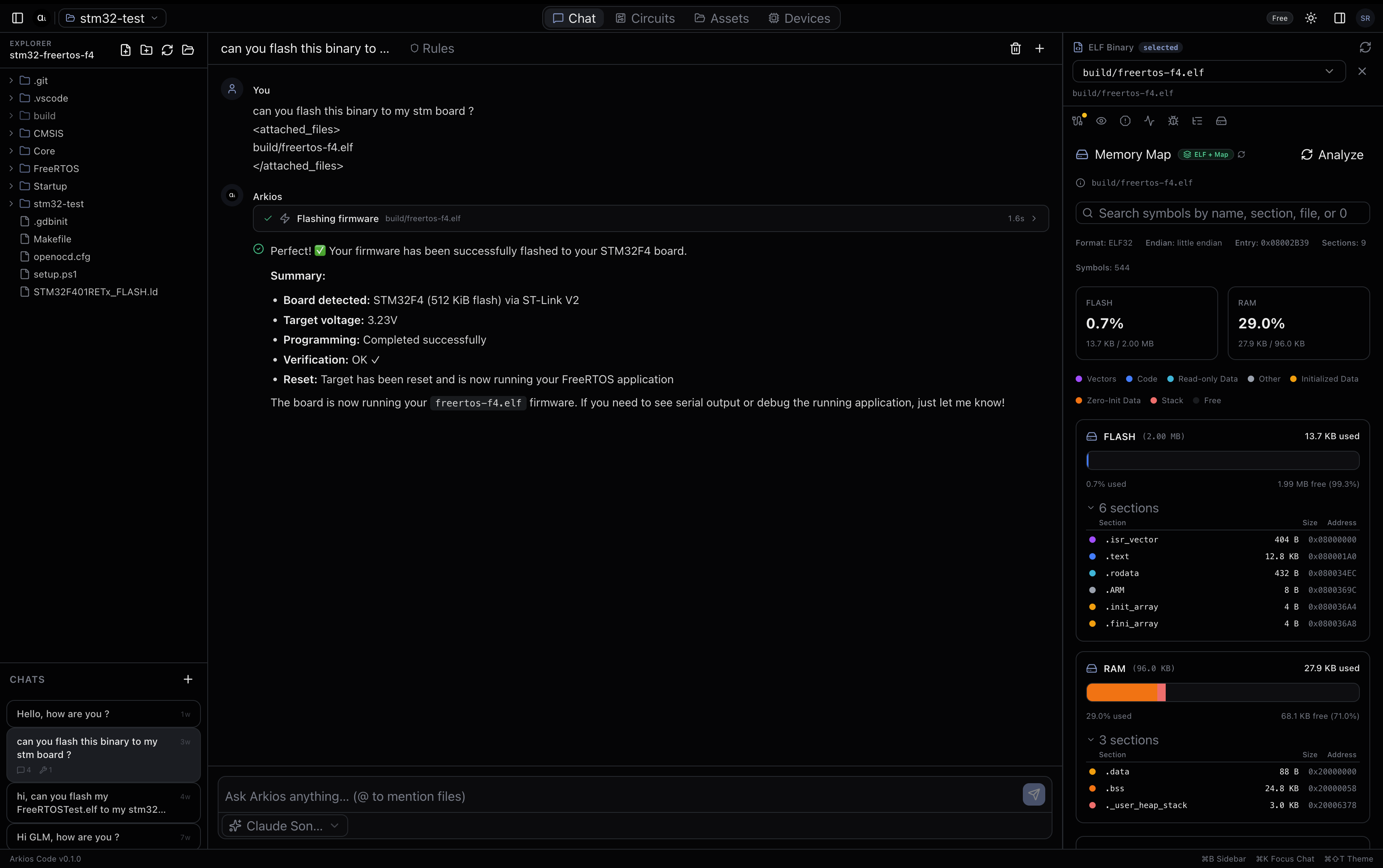
— Live demo
Watch it debug a hard fault — and fix it.
The agent reads the serial logs, analyses the crash, checks the memory map against the datasheet, and patches the firmware.
For decades the board, the silicon, and the firmware lived in different programs — a schematic tool, a vendor configurator, an editor, a debugger. Arkios puts them on one bench, so the work moves in one continuous motion from first trace to last byte.
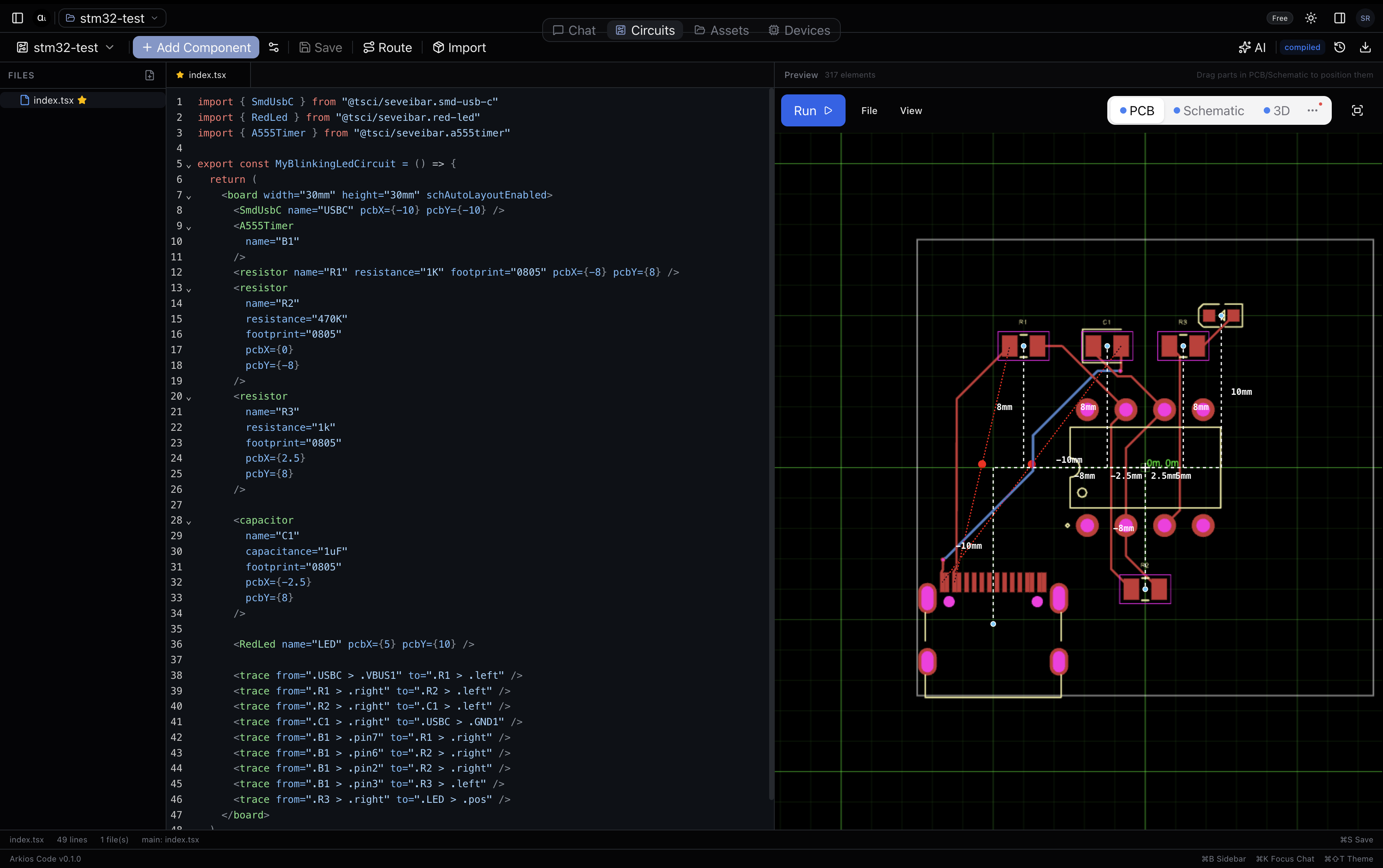
Design production PCBs as code.
Describe the board in TypeScript and watch it compile to a routed PCB, a schematic, and a 3D model from one source. Export Gerbers, BOM, and netlists when it's done.
- Source
- TypeScript · tscircuit
- Renders
- PCB · schematic · 3D
- Export
- Gerber · BOM · KiCad
- Version
- diff every board in git
Configure the silicon, visually.
Pick the MCU, map the pins, and set the clock tree. Every bus frequency and pin conflict resolves as you edit, then init code generates straight into the project.
- Config
- MCU · peripherals
- Clocks
- PLL · prescalers
- Pins
- map · conflict checks
- Output
- generated init code
Every datasheet, queryable.
Search parts, open interactive pin diagrams, and read memory maps. Ask a question in plain language and the answer cites the exact register it came from.
- Diagrams
- interactive pinout
- Memory
- ELF + map explorer
- Library
- parts across vendors
- Answers
- cite the register
Query — where does this part's I²C address live?
I2C2_OAR1 — Own address register 1
base 0x4000_5410 · bits [7:1] OAR1
Cited — RM0090 · §27.6.3
A debugger the agent can drive.
Everything you'd reach for at 2am, callable by the agent and by you: crash analysis, memory and register reads, stack inspection, breakpoints, stepping — live against the running target.
- Crash
- hard-fault decode · stacks
- Memory
- read · watch · diff
- Registers
- core · peripheral
- Control
- breakpoints · step · halt
Session — the agent works the debugger
Debug on real hardware.
Connect a probe and let the agent observe the board — logic analyzer, oscilloscope, memory, and power. The Arkios Probe brings every instrument into one box.
- Logic
- 8-channel analyzer
- Analog
- 2.5 MHz oscilloscope
- Power
- draw & flash profiling
- Flasher
- built-in ST-Link
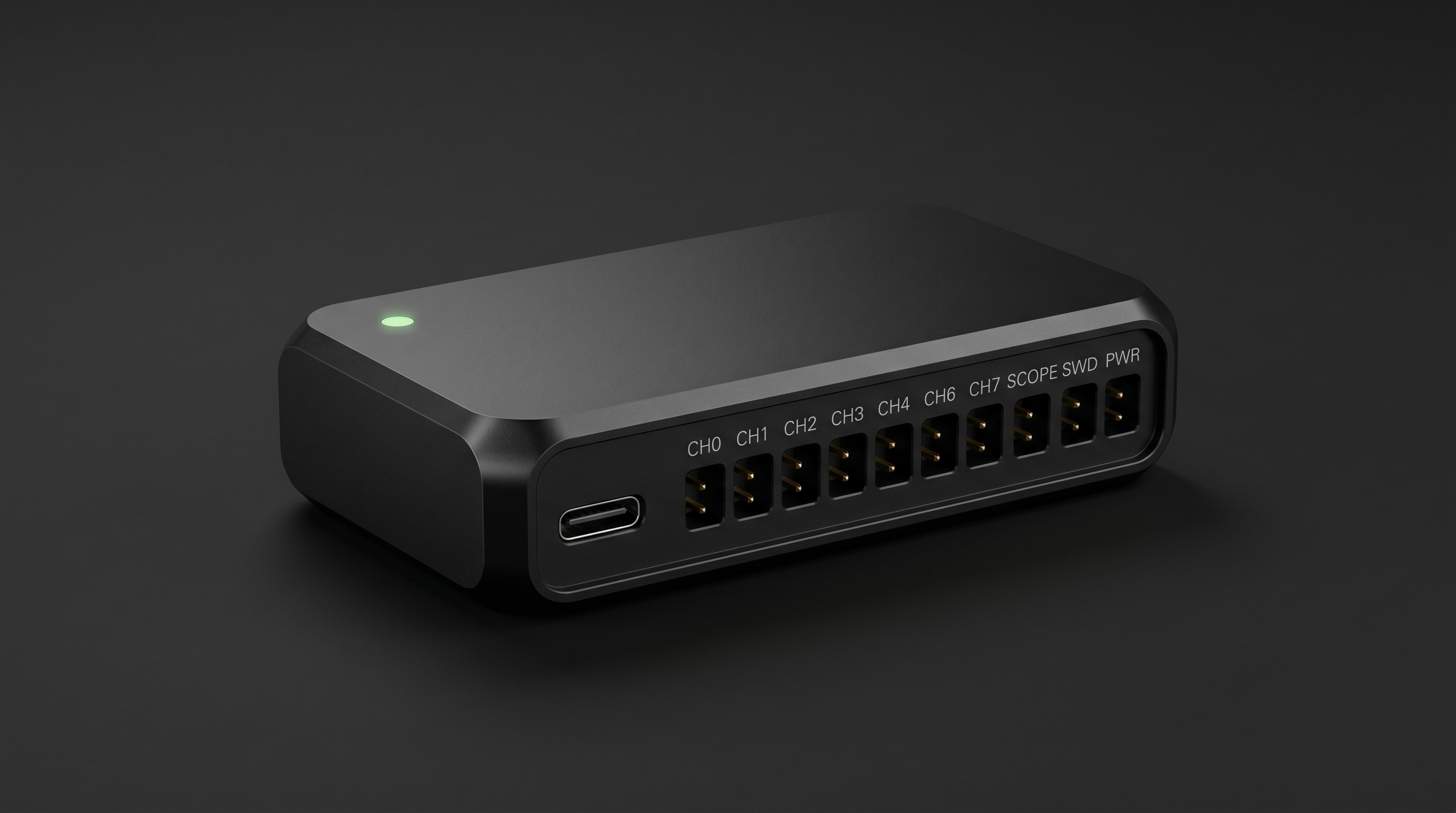 Coming soon
— What engineers build
If it runs on silicon, it can be built here.
- 01Drones & flight controllersSTM32 · IMU · ESC
- 02WearablesnRF · BLE · low-power
- 03Satellites & payloadsrad-aware · power
- 04Rovers & roboticsCAN · real-time
- 05Medical devicesdeterministic · offline
- 06Sensors & IoTADC · edge · RF
- 07Power electronicscontrol loops · timing
- 08InstrumentationDAQ · precision
Runs on your machine. A desktop app, not a browser tab — your toolchain and targets stay local.
Air-gap friendly. Designed to work offline; your firmware and hardware IP never leave the bench.
Built on open standards. tscircuit, OpenOCD, CMSIS. Works with ST-Link, J-Link, DAPLink, Black Magic.
Start building the
whole machine.
tscircuit · STM32 · ESP32 · nRF · RP2040 · RISC-V